
Introduction
When a tooth needs to be removed, one of the first questions patients ask is: do I have to wait a long time before getting an implant?
It is a fair question. The idea of walking around with a gap in your teeth — sometimes for months — while waiting for the site to heal is not exactly appealing. So when people hear that it is sometimes possible to place an implant on the same day as the extraction, they are understandably curious.
The short answer is yes — immediate implant placement is a real and widely practised procedure. But it is not suitable for everyone or every situation. Whether it is an option for you depends on several clinical factors that only a thorough dental assessment can confirm.
This blog explains how immediate implants work, when they are suitable, and what to realistically expect from the process.
What Is an Immediate Dental Implant?
A conventional dental implant is typically placed after allowing the extraction site to heal for anywhere between 2 to 6 months. This gives the bone and gum tissue time to recover fully before the implant is inserted.
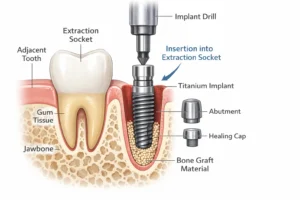
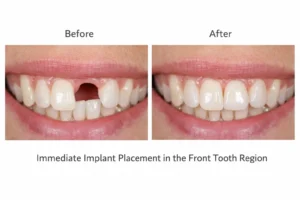
An immediate implant — also called a same-day implant — skips that waiting period. The tooth is extracted and the titanium implant post is placed into the same socket during the same appointment.
In some cases, a temporary crown is also attached on the same day, giving the patient a functional, natural-looking tooth almost immediately. This is sometimes referred to as immediate load implant or teeth in a day.
It sounds almost too good to be true. And while it genuinely is a well-established option in modern dentistry, it is important to understand that the outcome depends entirely on whether the clinical conditions are right.
When Is Immediate Implant Placement Possible?
Not every extraction site is suitable for an immediate implant. Your dentist will evaluate the following before recommending this approach.
Healthy Surrounding Bone
The implant needs sufficient, healthy bone to anchor into. If the tooth being extracted has caused significant bone loss — due to advanced gum disease, a long-standing infection, or a severe fracture — there may not be enough bone structure remaining for the implant to integrate properly. In these cases, a bone grafting procedure is done first, and the implant is placed after healing.
No Active Infection
This is a critical factor. If the tooth is being removed because of an acute abscess or an active infection that has spread into the surrounding tissue, placing an implant immediately is generally not advisable. Infection can interfere with the implant integrating with the bone and significantly raises the risk of failure.
A treated, resolved infection is a different matter — your dentist can assess whether the site is clean enough to proceed.
Sufficient Bone Depth Below the Socket
When an implant is placed into a fresh extraction socket, it needs to extend a few millimetres below the socket into the underlying bone to achieve what is called primary stability — essentially, a firm enough anchor to hold the implant steady while osseointegration (the process of the implant fusing with bone) takes place. If the socket is very wide or the bone below it is shallow, this stability may not be achievable immediately.
Good Overall Oral and General Health
Patients who smoke heavily, have uncontrolled diabetes, or are on certain medications that affect bone density may not be ideal candidates for immediate implants. These factors can impair healing and reduce the chances of successful integration.
What Are the Advantages of Immediate Implants?
When the conditions are right, immediate implant placement offers some genuine benefits.
Fewer appointments and less total treatment time. Combining extraction and implant placement into one procedure reduces the number of visits and, for many patients, the overall duration of treatment.
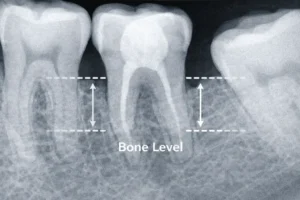
Preservation of bone and gum tissue. After a tooth is extracted, the surrounding bone naturally begins to shrink and resorb over time. Placing an implant immediately helps maintain the shape of the bone and the gum contour — which has a direct impact on how natural the final crown looks.
Psychological comfort. For front teeth especially, not having to spend months with a gap is a meaningful benefit. A temporary crown placed on the same day means the patient leaves the clinic with something that looks and functions like a tooth.
What Are the Risks and Limitations?
Immediate implants, when not indicated, carry a higher risk of failure than implants placed after full healing. The most common risks include:
- Failed osseointegration — the implant not fusing properly with the bone, particularly if the socket was not an ideal fit
- Infection — especially if any residual infection was present at the time of placement
- Aesthetic complications — slight gum recession around an immediately placed implant is more common than with a conventionally placed one, which can affect the final appearance
This is why patient selection matters so much. In the right case, immediate implants have excellent success rates. In the wrong case, the same procedure dramatically increases the chance of complications.
The Conventional Route — Is Waiting Always the Safer Choice?
Not necessarily. The conventional approach — waiting 2 to 6 months before placing an implant — is the more predictable route in complex or compromised cases, but it comes with its own drawback: progressive bone loss during the waiting period.
Every month after extraction, the jawbone in that area continues to shrink. In some cases, by the time a patient returns for their implant, a bone graft is needed to rebuild what has been lost — adding cost, time, and an additional surgical step to the process.
This is one reason why, when immediate placement is clinically viable, many dentists and patients choose it. It is not just about convenience — it is also about preserving the bone that is already there.
What Does the Procedure Actually Involve?
If your dentist confirms that you are a suitable candidate for an immediate implant, here is what the process typically looks like.
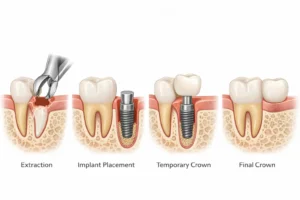
The tooth is extracted as carefully as possible, with the goal of preserving the surrounding bone and gum tissue. The socket is thoroughly cleaned and assessed. The implant — a small titanium post — is then carefully placed into the socket, extending into the bone below. If primary stability is confirmed, a temporary crown or a healing cap is attached.
Over the following 3 to 6 months, the implant fuses with the surrounding bone through a natural process called osseointegration. Once integration is confirmed, the temporary crown is replaced with the final, permanent one.
The entire timeline — from extraction to final crown — can be significantly shorter with immediate placement than with the conventional staged approach.
How Much Does an Immediate Implant Cost in India?
Immediate implant placement is generally priced similarly to conventional implants in India, with the total cost depending on the implant brand, the need for bone grafting, and the type of crown used.
As a rough guide, dental implants in India range from ₹25,000 to ₹1,20,000 per tooth depending on the implant system used. Internationally recognised implant brands sit at the higher end of this range. A temporary crown, if placed the same day, may be charged separately.
The most important thing to understand is that the cost of an implant — immediate or conventional — should be evaluated against the long-term cost of not replacing the tooth. A missing tooth causes the adjacent teeth to drift, the opposing tooth to over-erupt, and the bone to shrink — all of which create more complex and expensive problems down the line.
If you want to understand your specific options and what they would cost, a proper implant consultation with a clinical assessment is the only reliable starting point.
FAQs
- Is immediate implant placement painful? The procedure is done under local anaesthesia, so you will not feel pain during the appointment. Some soreness and swelling in the days following is normal and manageable. Most patients find the discomfort comparable to a standard extraction.
- Can immediate implants be done for back teeth (molars)? Yes, though it is less common than for front teeth. Back teeth sockets are wider and have multiple roots, which can make achieving primary stability more challenging. Each case needs to be assessed individually.
- What happens if I do not replace a missing tooth at all? The consequences build gradually. Adjacent teeth tilt and drift into the gap. The tooth above or below the gap over-erupts. The jawbone in the area begins to shrink. Over time, what starts as one missing tooth can create a cascade of alignment and bone loss issues.
- How long do dental implants last? With proper care, dental implants can last a lifetime. The crown on top may need replacement after 10 to 15 years due to normal wear, but the implant itself — once integrated — is designed to be permanent.
- How soon can I eat normally after an immediate implant? Your dentist will advise a soft diet for several weeks to avoid putting pressure on the implant while it integrates. Normal eating typically resumes gradually as healing progresses.
Published by Vivaan Dental Clinic | Sector 90, Gurugram Have a tooth that needs to be removed? Ask us whether an immediate implant could be the right option for you.