Introduction
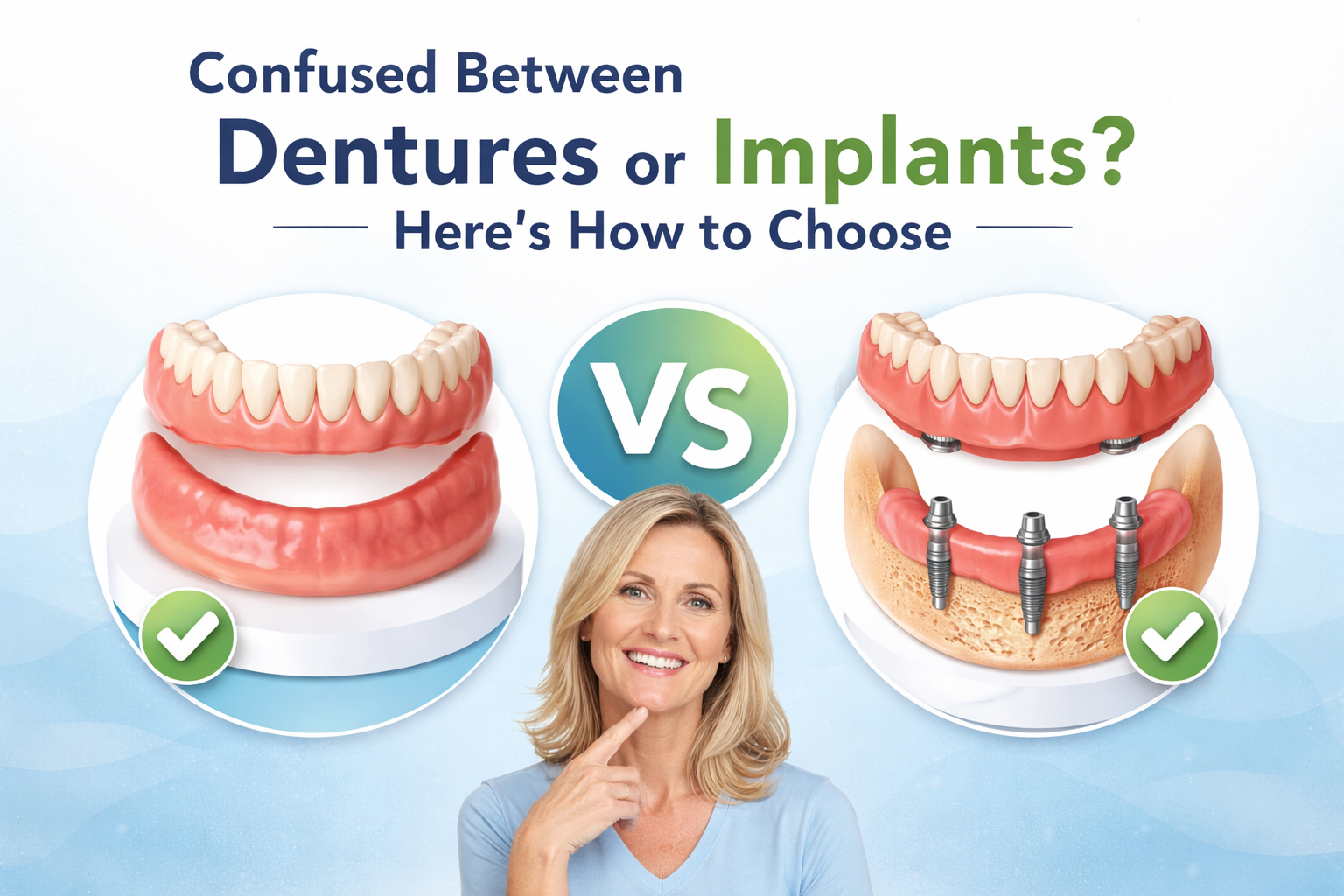
If you are dealing with one or more missing teeth, you have likely come across two options more than any others — dentures and dental implants. Both replace missing teeth. Both restore your ability to eat and speak more comfortably. But beyond that, they are quite different in how they work, how they feel, and what they cost.
The question of which one is right for you is not something with a universal answer. It depends on your specific situation — your bone health, how many teeth are missing, your budget, your age, and what matters most to you in daily life.
This blog gives you an honest, side-by-side look at both options so you can walk into your dental consultation already knowing the right questions to ask.
First, a Quick Overview of Each Option
What Are Dentures?
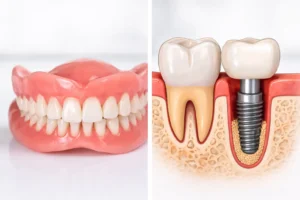
Dentures are removable prosthetic teeth — either a full set replacing all teeth in one jaw, or a partial denture that replaces several missing teeth while the remaining natural teeth stay in place. They sit on the gum and are held in position either by suction, clasps onto remaining teeth, or dental adhesive.
Modern dentures are far more natural-looking and comfortable than they used to be. They are also the faster and more affordable route to restoring a smile when multiple or all teeth are missing.
What Are Dental Implants?
A dental implant is a titanium post surgically placed into the jawbone, acting as an artificial tooth root. A crown is attached on top, creating a replacement tooth that looks, feels, and functions almost exactly like a natural one. Implants are fixed — they do not come in and out.
For people missing multiple or all teeth, implant-supported bridges or implant-supported dentures (sometimes called All-on-4 or All-on-6) combine the stability of implants with the coverage of dentures.
Dentures vs Implants — A Side-by-Side Comparison
1. Look and Feel
Implants are widely considered the closest thing to natural teeth. Because they are anchored into the bone, they feel completely stable. There is no movement, no slipping, no adjustment period for speech. Most people forget they have an implant within a few weeks.
Dentures have improved significantly in terms of aesthetics — well-made dentures look natural. But the feel is different. They sit on the gum rather than integrating with the bone, and some movement is normal, particularly full lower dentures. Many people adapt well, but it takes time and some conscious adjustment.
2. Eating Comfort
This is an area where the difference is most noticeable in daily life.
Implants restore nearly full biting force. You can eat most foods — including hard and chewy ones — without restriction or worry. There is no risk of the tooth shifting while you eat.
Dentures require some dietary adaptation. Hard, sticky, or very chewy foods can dislodge or put excessive pressure on dentures. Over time, most denture wearers develop habits around what they eat — but it is a real lifestyle adjustment that some people find more challenging than others.

3. Bone Health
This is one of the most clinically significant differences between the two options — and one that is often underexplained to patients.
When a tooth is lost, the jawbone in that area no longer receives stimulation from chewing. Without that stimulation, the bone gradually shrinks — a process called bone resorption. Over months and years, this can change the shape of your face, cause the cheeks to look sunken, and affect how well dentures fit.
Implants prevent this. Because the titanium post integrates with the bone and transmits chewing forces into it, the bone is stimulated and largely preserved. This is one of the most important long-term advantages of implants — not just for dental health, but for facial structure.
Dentures do not prevent bone loss. In fact, the pressure of a denture sitting on the gum can sometimes accelerate resorption. As the bone changes shape over years, dentures that once fit well begin to loosen — requiring relining or replacement.
4. Maintenance and Care
Implants are maintained exactly like natural teeth — brushing, flossing, and regular dental check-ups. There are no special soaking routines, no adhesives, and no need to remove them at night. With proper care, a well-placed implant can last a lifetime.
Dentures require daily removal, soaking in a cleaning solution overnight, and careful brushing. The gums beneath them also need to be cleaned. Over time, the fit changes and periodic adjustments or relines are needed. Full dentures typically need to be replaced every 5 to 10 years.
5. Cost
This is often the deciding factor — and it is important to look at both short-term and long-term cost.
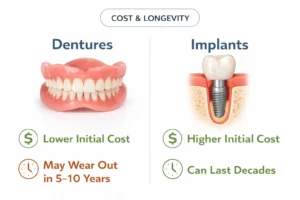
Dentures are considerably less expensive upfront. A full set of dentures in India can range from ₹10,000 to ₹80,000 depending on the material and type. Partial dentures are typically more affordable. For patients on a tight budget or those who need an immediate, widespread solution, dentures are the more accessible route.
Implants involve a higher initial investment. A single implant in India typically costs between ₹25,000 and ₹1,20,000. For full-mouth restoration using All-on-4 or All-on-6 implants, the cost is significantly higher. However, implants do not typically require replacement if well maintained — making the long-term cost-per-year more competitive than it initially appears.
A patient who gets dentures at 45 may go through two or three sets by the time they are 70. An implant placed at the same age, with proper care, may still be in place decades later.
6. Procedure and Timeline
Dentures can be provided relatively quickly — the process involves impressions, measurements, fitting, and adjustments, typically across 3 to 5 appointments over a few weeks. Immediate dentures can sometimes be fitted the same day as extractions.
Implants take longer. From placement to final crown, the process typically spans 3 to 6 months to allow for bone integration. In cases where bone grafting is needed, the timeline extends further. That said, temporary restorations can often be placed in the interim so the patient is not left without teeth during healing.
So Which One Is Right for You?
Rather than a simple winner, think of it as matching the right solution to the right situation.
Dentures may be the better fit if:
- You are missing most or all of your teeth and need an affordable, immediate solution
- Bone loss has already significantly reduced the bone available for implants
- Your general health makes surgery inadvisable
- Budget is a primary constraint
Implants may be the better fit if:
- You are missing one or a few teeth and want a permanent, natural-feeling result
- You want to preserve jawbone and avoid the long-term effects of bone loss
- You want a solution that requires no special care routine or dietary changes
- You are looking at the cost over a 10 to 20-year horizon rather than just upfront
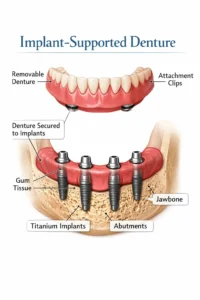
There is also a middle ground worth knowing about — implant-supported dentures — where two to four implants are placed to anchor a denture, giving it far more stability than a conventional removable denture. This can be a compelling option for patients who need full-arch replacement but want better function than standard dentures provide.
The Most Important Step: A Proper Assessment
Reading a comparison like this one can help you think through the decision — but it cannot replace a clinical evaluation. Factors like the amount of bone present, the condition of your remaining teeth, your gum health, and your medical history all play a role in determining what is actually viable for you.
If you are considering either option, a consultation with an experienced dentist is the essential first step. An X-ray and clinical assessment will show exactly what you are working with — and from there, the right recommendation will follow.

FAQs
- Can I switch from dentures to implants later if I start with dentures now? In many cases, yes — though prolonged denture use can lead to bone loss that may require grafting before implants can be placed. It is always worth discussing the full picture with your dentist early so you are making a fully informed choice.
- Are dental implants painful? The procedure is done under local anaesthesia, so there is no pain during placement. Post-operative soreness is normal for a few days and is manageable. Most patients are surprised by how comfortable the recovery is.
- How long do dentures last? With proper care, dentures typically last 5 to 10 years before they need to be replaced. The fit may need adjustment sooner as the jawbone changes shape over time.
- Can everyone get dental implants? Not everyone is immediately suitable. Insufficient bone, uncontrolled diabetes, heavy smoking, and certain medications can affect candidacy. A thorough assessment will determine whether implants are viable or whether preparatory treatment is needed first.
- Will my dentures or implants look natural? Both can look very natural when made and placed well. Implant-supported crowns are generally considered the most aesthetically seamless option. High-quality dentures made with good materials are also far more natural in appearance than older generations of dentures.
Published by Vivaan Dental Clinic | Sector 90, Gurugram Not sure which option suits your situation? Come in for an assessment — we will walk you through everything clearly, without pressure.