Introduction
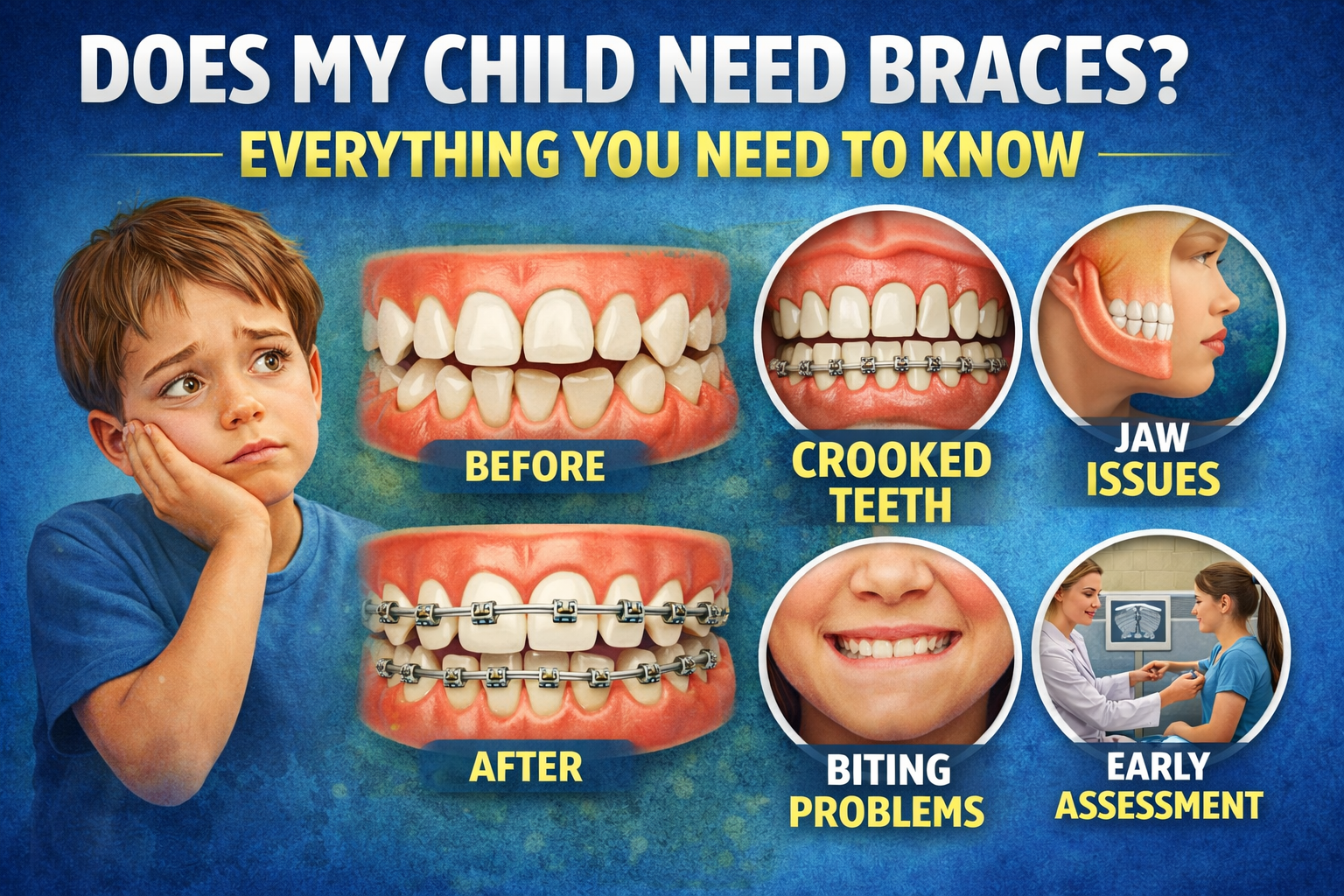
As a parent, watching your child’s permanent teeth come in can be both exciting and a little nerve-wracking. Teeth do not always arrive neat and straight — and when you notice crowding, gaps, or a bite that does not look quite right, it is natural to wonder whether braces are going to be part of the picture.
The honest answer is: maybe. Not every child needs braces, and not every crooked tooth at age eight is a problem that requires intervention. But some issues, if left unaddressed, do become harder and more expensive to correct with time.
This guide will help you understand the signs to look for, the right time to seek an assessment, and what orthodontic treatment actually involves for children.

What Age Should a Child First See an Orthodontist?
The general recommendation among orthodontists is an initial assessment at around age 7.
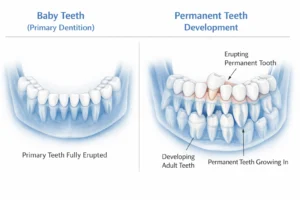
This might seem early, especially if your child still has many baby teeth. But the purpose of an early assessment is not necessarily to start treatment — it is to give the orthodontist a picture of how the teeth and jaw are developing. At this age, there is enough permanent teeth present to identify patterns, and the jaw is still growing, which makes early correction — if needed — far more effective.
Think of it less as “starting braces at 7” and more as “getting a map of what is coming and when to act.”
Most active orthodontic treatment begins between ages 10 and 14, once most permanent teeth have come through. But the earlier a potential issue is spotted, the more options a dentist has to manage it.
Signs Your Child May Need Braces
Every child is different, and only a dentist can confirm whether treatment is needed. That said, there are several signs worth paying attention to.
1. Crowded or Overlapping Teeth
This is the most common reason children are referred for orthodontic assessment. When the jaw does not have enough space for all the permanent teeth, they begin to push against each other — coming in at angles, overlapping, or getting stuck partially behind other teeth.
Crowding does not always look dramatic. Sometimes it is subtle — a single tooth that is slightly rotated, or two teeth that overlap just a little. But even minor crowding can make thorough brushing and flossing difficult, increasing the risk of decay and gum problems over time.
2. Gaps Between Teeth
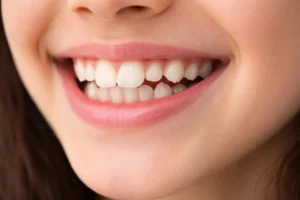
Spacing issues — gaps between teeth — can also be a sign that orthodontic treatment would help. While some gaps close naturally as more permanent teeth come through, others persist and may affect bite function or how food gets trapped between teeth.
A gap between the two upper front teeth (called a diastema) is particularly common in children and often closes on its own. An orthodontist can tell you whether a gap is likely to self-correct or whether it needs attention.
3. Bite Problems
Bite issues are among the more important reasons to seek an orthodontic opinion — not just for aesthetics, but for function and long-term dental health.
Common bite problems in children include:
- Overbite — the upper front teeth overlap too far over the lower teeth
- Underbite — the lower jaw protrudes forward, causing the lower teeth to sit in front of the upper ones
- Crossbite — some upper teeth sit inside the lower teeth instead of outside
- Open bite — the upper and lower front teeth do not meet when the mouth is closed
These issues can affect how a child chews, speaks, and even how the jaw develops over time. They tend to be easier to correct during childhood — when the jaw is still growing — than in adulthood.
4. Mouth Breathing or Thumb Sucking
Prolonged thumb sucking or finger sucking — especially beyond age 5 — can push the upper front teeth forward and affect how the upper jaw develops. Similarly, children who habitually breathe through their mouth (rather than the nose) often develop a narrower upper jaw and specific bite patterns over time.
If either of these habits is present, it is worth mentioning to your child’s dentist at their next visit.
5. Losing Baby Teeth Too Early or Too Late
Baby teeth act as natural placeholders for permanent teeth. If a baby tooth is lost too early — due to decay or injury — the surrounding teeth may shift into that space, leaving insufficient room for the permanent tooth when it comes through.
Conversely, if baby teeth are retained for too long, they can block permanent teeth from emerging properly. In both cases, a dental assessment can determine whether any intervention or monitoring is needed.
6. Your Child Complains of Jaw Pain or Difficulty Chewing
If your child mentions that their jaw aches, clicks, or that chewing is uncomfortable, this can point to a bite issue that is placing uneven pressure on the jaw joint. These complaints should not be dismissed as “growing pains” — they are worth investigating with a dental check-up.
What Happens at an Orthodontic Assessment?
If you decide to book an assessment, here is what to expect. The visit is typically straightforward and non-invasive.
The orthodontist will examine your child’s teeth, jaw alignment, and bite. They may take X-rays to see how the permanent teeth are positioned below the gumline and how the jaw is developing. In some clinics, a 3D scan is used for a more detailed picture.
Based on this, the orthodontist will tell you one of three things: treatment is needed now, treatment may be needed later and monitoring is advisable, or no intervention is required at all. There is no pressure to start treatment immediately.
Types of Braces Used for Children
If treatment is recommended, the options available for children are broadly the same as for adults — though metal braces remain the most common for younger patients because they are durable, effective, and typically the most affordable.
For teenagers, ceramic braces and clear aligners are increasingly popular choices — particularly for those who are self-conscious about the look of metal braces. The right option depends on the child’s age, the complexity of their case, and, practically speaking, how reliably they will follow the care instructions.
Clear aligners, for instance, need to be worn for at least 20 to 22 hours a day to be effective. For a disciplined teenager, that is fine. For a younger child who might lose or forget their aligners, fixed braces are often the more sensible choice.
For a detailed breakdown of what each type of braces costs in India, our earlier guide to braces costs covers all the options.

How Long Does Treatment Take for Children?
Treatment duration depends on how much correction is needed. Most children complete their orthodontic treatment within 18 to 30 months. Simpler cases can be shorter. More complex bite corrections may take longer.
After braces are removed, a retainer is used to keep the teeth in their new position — typically worn full-time initially, then just at night. This phase is just as important as the treatment itself. Skipping the retainer is one of the main reasons teeth shift back after braces.
When Is It Too Late to Act?
The short answer: it rarely is. Adults get orthodontic treatment successfully all the time. But childhood and early teenage years remain the ideal window — the jaw is still growing, teeth move faster, and outcomes are generally easier to achieve.
If you have been thinking about getting your child assessed and keep pushing it off, the only thing lost by waiting is time — and sometimes, the simpler treatment option that was available earlier.

FAQs
- My child’s teeth look slightly crooked but they are not bothered by it. Should I still get them checked? Yes, it is worth an assessment. Some issues that look minor on the surface — like a slight crossbite — can have functional effects that are not immediately obvious. An orthodontist can tell you whether watchful waiting is fine or whether early action would help.
- Will braces be painful for my child? There is typically some tenderness after each adjustment appointment, lasting a day or two. It is manageable with soft foods and, if needed, over-the-counter pain relief. Most children adjust to the feeling of braces fairly quickly.
- Can my child play sports with braces? Yes. A mouthguard is recommended during contact sports to protect both the braces and the teeth. Your orthodontist can advise on the right type.
- What if my child refuses to wear their retainer after braces? This is a common challenge. Without the retainer, teeth can shift back — gradually reversing the results of treatment. Make sure your child understands this. Fixed retainers (bonded behind the teeth) are also an option for children who find removable ones difficult to manage consistently.
Published by Vivaan Dental Clinic | Sector 90, Gurugram If you are unsure whether your child needs braces, an early assessment is the best first step. We are here to answer your questions.